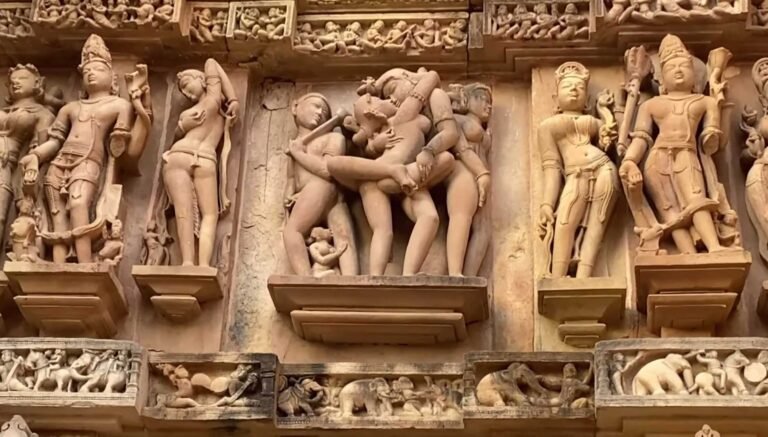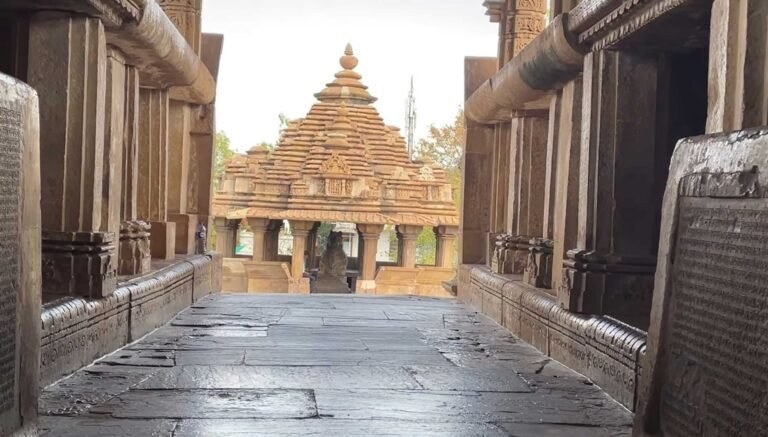
The Khajuraho temples are a group of old stone temples in Madhya Pradesh. They are about 1,000 years old. People from all over the world come to see their fine stone carvings. In 1986, UNESCO made them a World Heritage Site.
Long ago, there were about 85 temples here. Today, only about 22 are still standing. They are in three groups: the Western Group, the Eastern Group and the Southern Group.
This guide explains the Khajuraho temples in simple words. If you want us to plan your visit, see our Khajuraho tour packages.
Khajuraho Temple: Quick Facts
Where Is the Khajuraho Temple?
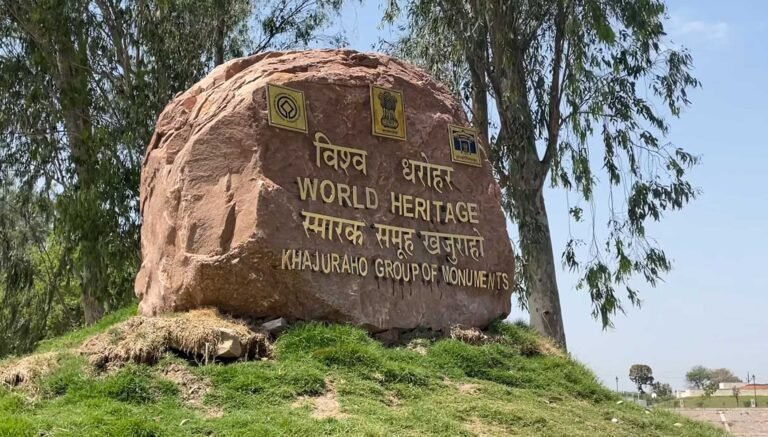
The temples are in the small town of Khajuraho, in the Chhatarpur district of Madhya Pradesh. This area is called Bundelkhand.
The main temples, the Western Group, are right in the middle of the town. The Eastern Group is about 2 km away, near the old village. The Southern Group is a few kilometres to the south.
Who Built the Khajuraho Temples?
The temples were built by the Chandela kings. The Chandelas ruled this part of central India from about the 9th to the 13th century. Khajuraho was one of their important cities.
Most temples were built in about 100 years, between 950 and 1050. Different kings built different temples:
- YashovarmanLakshmana Temple (finished around 954)
- DhangaVishwanath Temple (around 1002)
- VidyadharaKandariya Mahadev Temple (around 1030)
Later, the Chandela kings moved their capital to other places, like Mahoba and Kalinjar. Slowly, Khajuraho became a quiet village. Forest grew around the temples. Because the town was far from big roads, the temples stayed safe.
In 1838, a British officer named T.S. Burt wrote about the temples. After that, the world came to know about them again.
Where does the name come from?
"Khajur" means date palm. People believe many date palm trees once grew here. The old name of the town was Kharjuravahaka.
Why Is the Khajuraho Temple Famous?
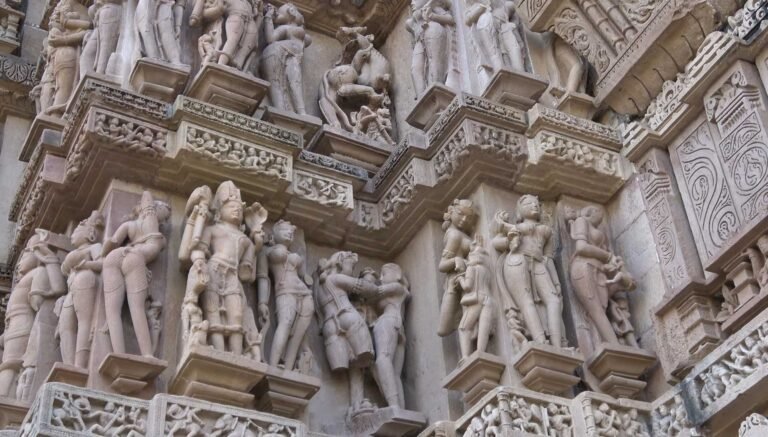
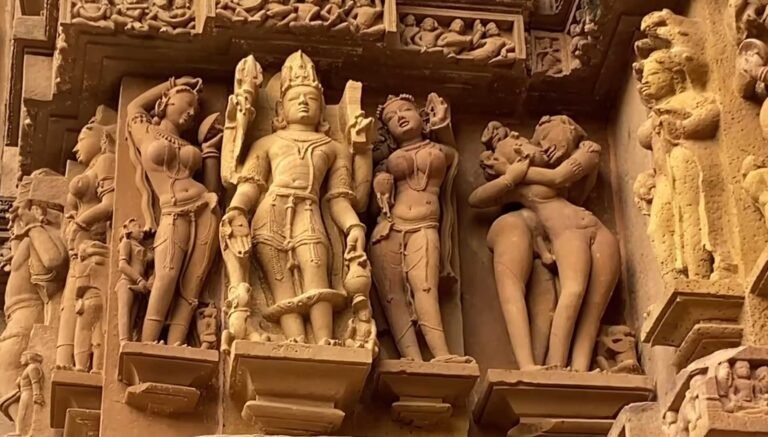
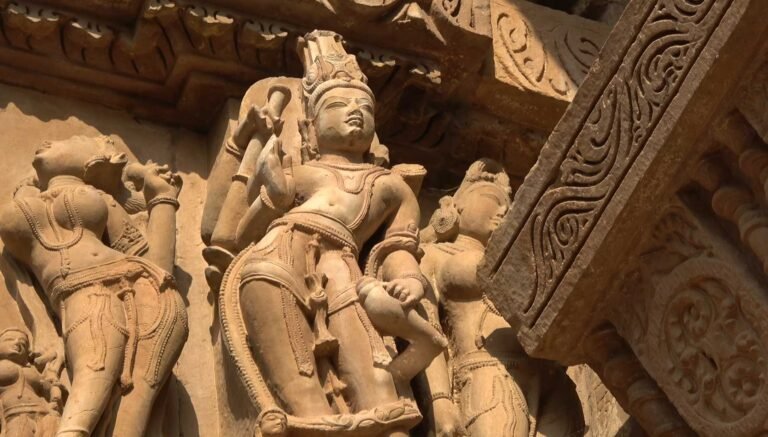
Khajuraho is famous for its stone carvings. Almost every wall is covered with figures. You can see:
- Gods and goddesses
- Dancers and musicians
- Soldiers, horses and elephants
- Women dressing up, writing letters or playing with a ball
- People working, cooking and praying
- Love scenes between men and women
Many people think Khajuraho is only about love carvings. This is not true. Only about one tenth of the carvings show love scenes. Most of them show daily life, gods and nature. The temples show that, in old India, art, faith and daily life were all seen as part of one life.
Khajuraho Temple Architecture
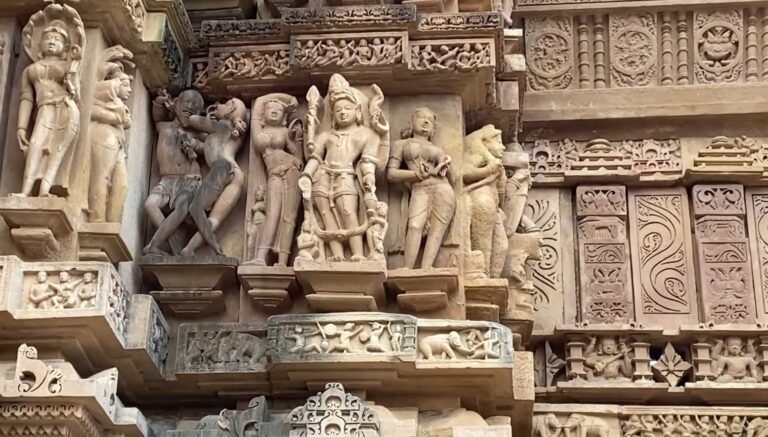
The Khajuraho temples are built in the Nagara style of North India. Most temples have the same parts, one after another, from the gate to the inside:
The tops of the bigger temples rise one above the other, like mountain peaks. This makes the temples look like Mount Kailash, the home of Lord Shiva.
The stone came from the sandstone hills near the Ken River. The blocks were joined without cement. They were cut so well that they fit together on their own.
Western Group of Temples Khajuraho
This is the main and most visited group. The temples are inside one big garden with a wall around it. You need a ticket to go in.

Kandariya Mahadev Temple
The biggest and finest temple in Khajuraho. It is for Lord Shiva. Its top is about 31 metres high. It has more than 800 carved figures.
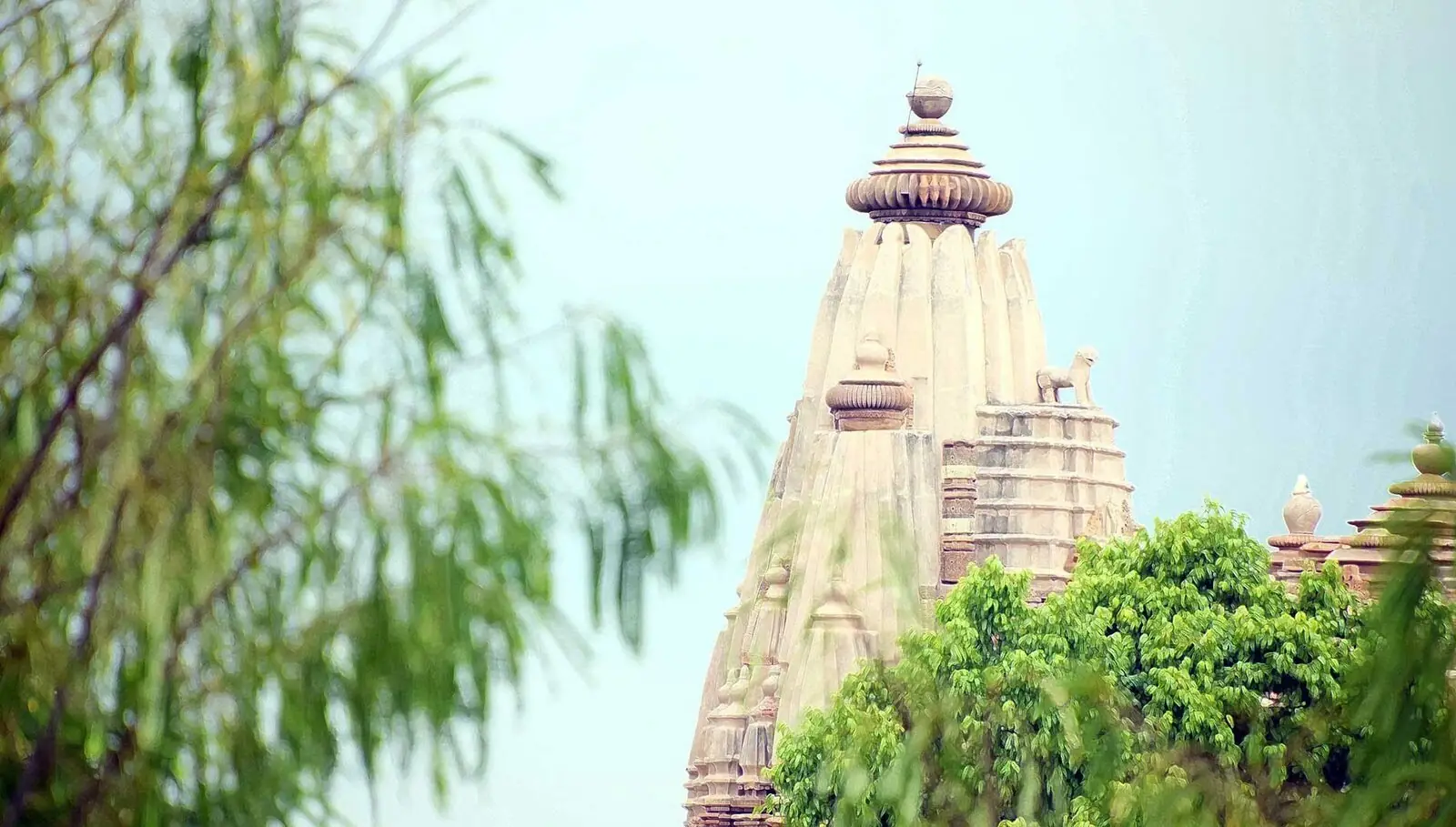
Lakshmana Temple
One of the oldest and best-kept temples. It is for Lord Vishnu. The long bands of carvings around its base show armies, hunting and daily life.
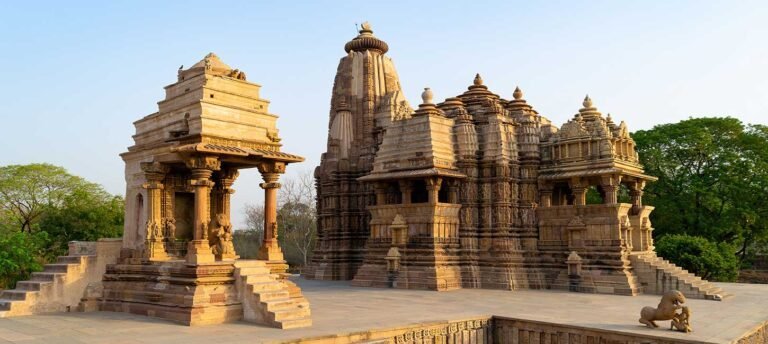
Varaha Temple
A small open hall with a big stone boar inside. The boar is Varaha, a form of Vishnu. Its body is covered with tiny figures.
Vishwanath Temple
A large Shiva temple. In front of it is a hall with a big stone Nandi bull.
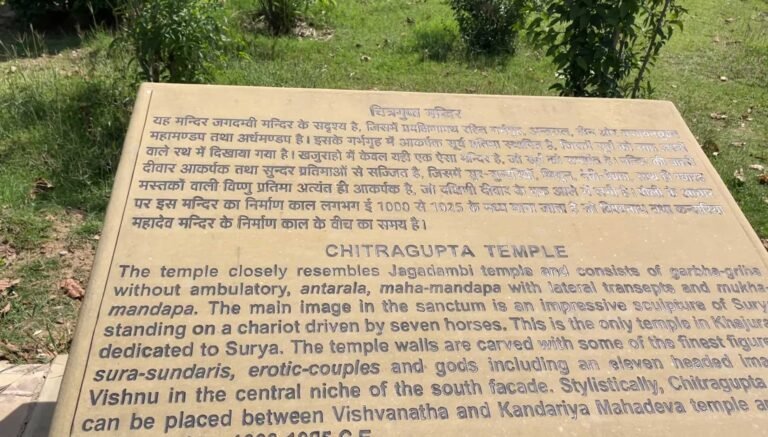
Chitragupta Temple
A temple for Surya, the Sun God. Surya stands on a chariot pulled by seven horses.
Devi Jagadambi Temple
A smaller temple for the Mother Goddess. It is known for its graceful female figures.
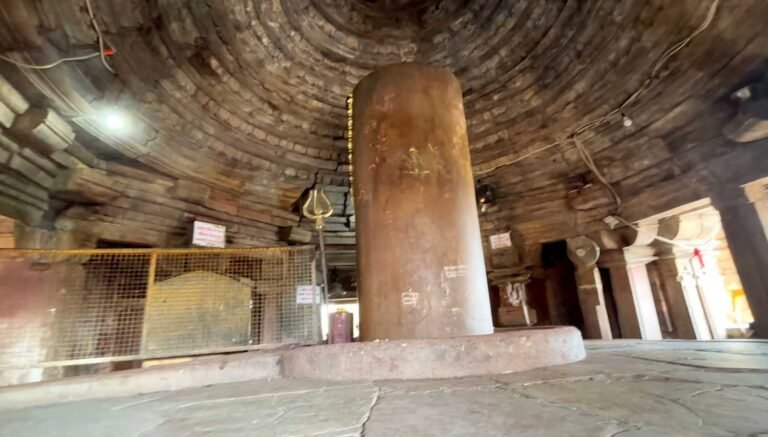
Matangeshwar Temple
This Shiva temple stands just outside the garden wall. It is the only old temple here where daily prayers still happen. Its Shiva Linga is about 2.5 metres tall.
Chausath Yogini Temple
The oldest temple in Khajuraho, made of rough granite. It is near Shiv Sagar Lake and is mostly in ruins now.
Eastern Group of Temples Khajuraho
The Eastern Group is near the old village of Khajuraho, about 2 km from the Western Group. It has two parts: a group of Jain temples inside a walled area, and a few Hindu temples spread out in the fields. Most of these temples are free to visit.
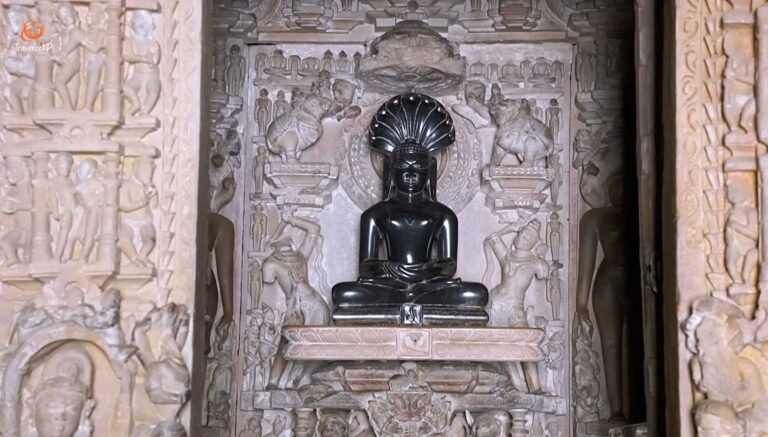
Parsvanath Temple
This is the biggest Jain temple in Khajuraho. It is for Lord Parsvanath, the 23rd Jain Tirthankara. Its outer walls have some of the finest carvings in the whole town. The figures of women putting on make-up and jewellery are very famous.
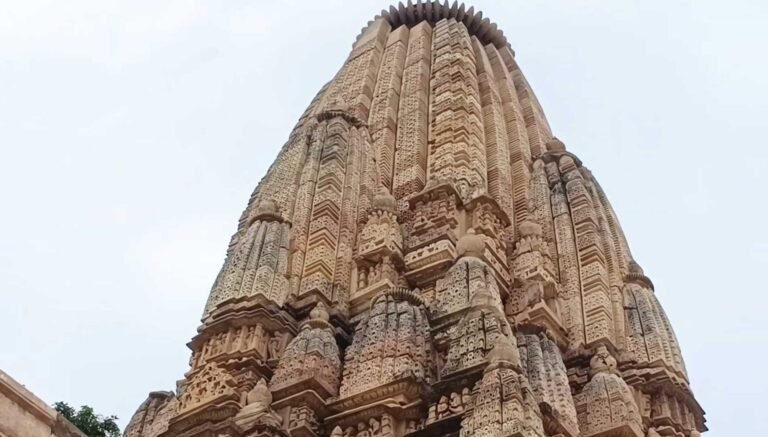
Adinath Temple
A small Jain temple next to the Parsvanath Temple. It is for Lord Adinath, the first Tirthankara. Its tall top is covered with neat carvings, much like the Hindu temples.
Shantinath Temple
Jain people still pray here every day. Inside is a tall standing statue, about 4.5 metres high. Please take off your shoes and stay quiet.
Ghantai Temple
Only the pillars and the front of this Jain temple are left. The pillars have carvings of bells hanging from chains. "Ghanta" means bell, which gave the temple its name.
Javari Temple
A small, tall and slim temple for Lord Vishnu. It has a lovely carved gate at the front.
Vamana Temple
A temple for Vamana, the dwarf form of Lord Vishnu. It stands alone in an open field, so you can walk all around it.
Brahma Temple
A small, old temple near Ninora Tal lake. It is called the Brahma Temple, but inside there is a Shiva Linga with four faces.
Tip: The Eastern Group is quiet and has fewer visitors. It is a good place to see the carvings slowly and up close.
Southern Group of Temples Khajuraho
The Southern Group has two main temples, a few kilometres south of the town. You can reach them by auto, cab or bicycle. They are free and very peaceful.
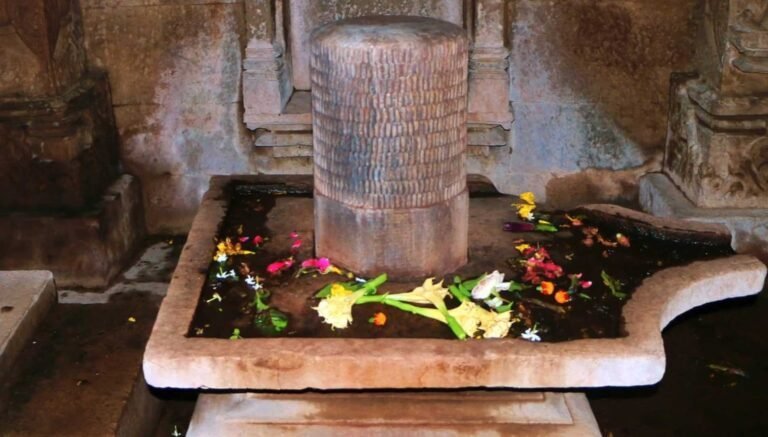
Duladeo Temple
This Shiva temple was one of the last temples built in Khajuraho, around the year 1130. "Duladeo" means "the holy groom". Inside is a Shiva Linga with many small Lingas carved on its surface. The carvings of flying heavenly women here are very fine.
Chaturbhuj Temple
This temple has a tall statue of Lord Vishnu with four arms. "Chaturbhuj" means "one with four arms". The statue is about 2.7 metres tall. This is the only large temple in Khajuraho with no love carvings. It faces west, so many visitors come here to watch the sunset. Near the Chaturbhuj Temple are the ruins of the Bijamandal Temple. It was a very big temple, but today only its base is left.
Khajuraho Temple Timings and Ticket
Tips for Visiting the Khajuraho Temples
- Start with the Western Group early in the morning. The light is soft and it is cool.
- Hire a guide at the Western Group. A good guide will show you details you will miss on your own.
- Wear comfortable shoes and carry water and a cap.
- Dress simply when you visit temples where people still pray.
- See the Light and Sound Show in the evening to hear the story of the Chandela kings.
Want an easy trip? We can book your hotel, car and guide in one go. See our Khajuraho trip packages or call +91 92850 11011. Want to see more of the state? Explore our Madhya Pradesh tour packages.
Frequently Asked Questions
Who built the Khajuraho temple?
The Chandela kings built the Khajuraho temples, mostly between the years 950 and 1050.
Where is the Khajuraho temple?
It is in the town of Khajuraho, in the Chhatarpur district of Madhya Pradesh.
How many temples are there in Khajuraho?
There were about 85 temples. Today about 22 temples are still standing.
Why is the Khajuraho temple famous?
It is famous for its fine stone carvings of gods, dancers, daily life and love. It is a UNESCO World Heritage Site.
What is in the Eastern Group of temples in Khajuraho?
The Eastern Group has Jain temples like Parsvanath, Adinath and Shantinath, and Hindu temples like Javari, Vamana and Brahma.
What is in the Southern Group of temples in Khajuraho?
The Southern Group has the Duladeo Temple and the Chaturbhuj Temple, and the ruins of the Bijamandal Temple.
Are all the carvings in Khajuraho about love?
No. Only about one tenth of the carvings show love scenes. Most show gods, daily life, animals and nature.