
Jantar Mantar Ujjain
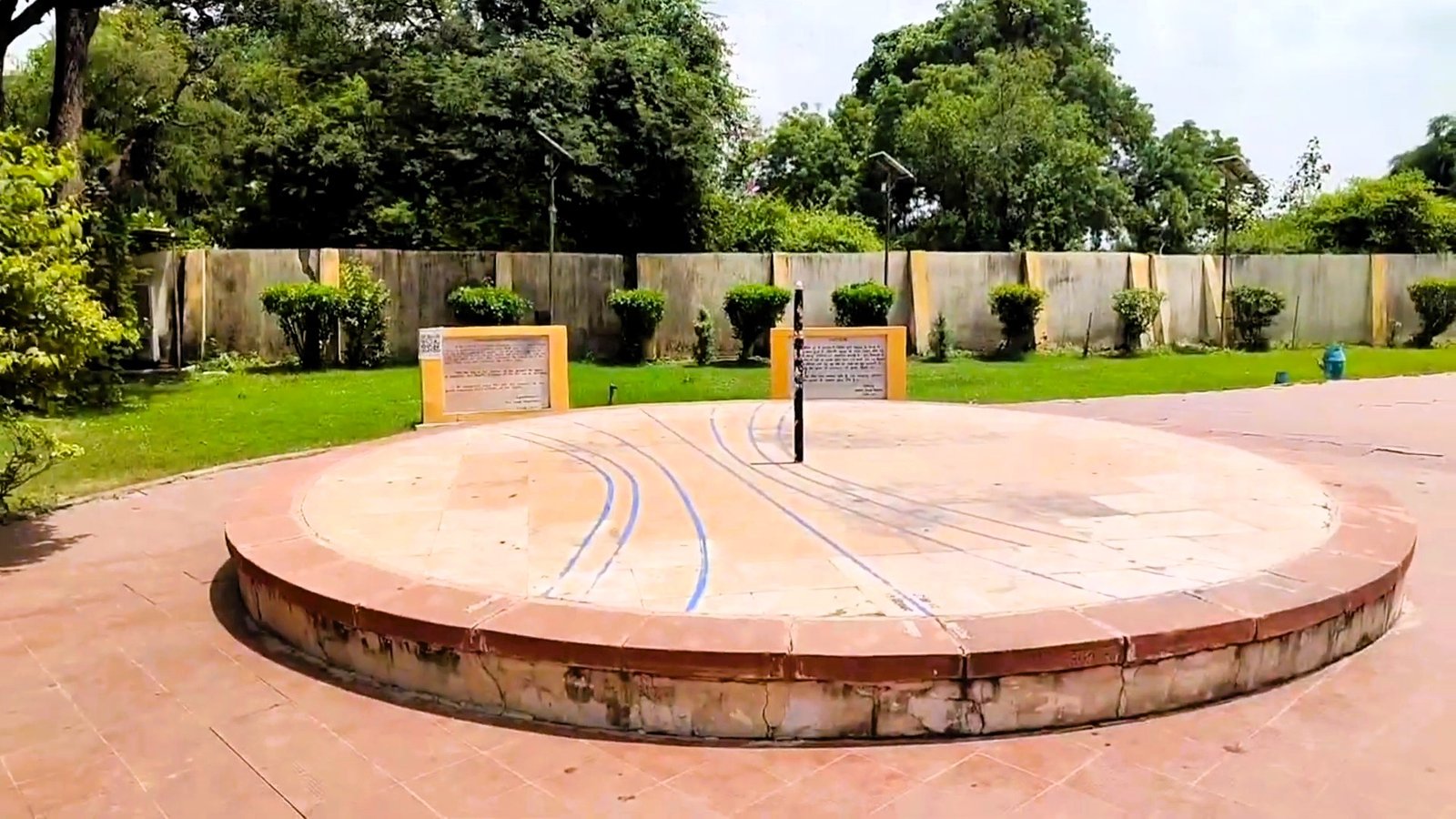
Table of Contents
Jantar Mantar, Ujjain: The 18th-Century Stone Observatory That Still Tracks the Sky
No telescopes, no computers — just giant stone instruments that calculated time and planetary positions almost 300 years ago, and some still work today.
Long before satellites and software, a king built a set of stone machines in Ujjain to read the sky with nothing but the naked eye. The Jantar Mantar of Ujjain, also called Vedh Shala, is one of only five such observatories ever built in India — and it still publishes an annual calendar of planetary positions today.
Key Highlights
Detail | Information |
Also known as | Vedh Shala (Observatory) |
Built by | Maharaja Sawai Jai Singh II of Jaipur, while he served as governor of Malwa |
Year built | Around 1725–1730 AD (construction work began around 1719) |
Renovated | 1923 AD, by Maharaja Madhav Rao Scindia of Gwalior |
Type | Naked-eye astronomical observatory with 13 masonry instruments |
Location | Jaisinghpura, near Mahakaleshwar Temple area, Ujjain, Madhya Pradesh |
Special significance | Ujjain lies on the ancient Hindu prime meridian; some sources also place it near the Tropic of Cancer |
Visit duration | 30 to 60 minutes |
Timings | Generally open from 7.00 AM to 7.00 PM; midday visits are recommended since the sundial’s shadow is clearest when the sun is high. |
Entry fee | Charges may apply: Indian Visitors: ₹40 per person & foreign visitors: ₹200 per person; fees can change, so confirm locally before visiting. |
Best time to visit | Around midday, when the sundial shadow is most visible
|
Who Built It and Why
The observatory was commissioned by Maharaja Sawai Jai Singh II, the Rajput ruler of Amber and later Jaipur, who had a deep personal interest in astronomy and mathematics. He was unhappy with the inaccuracies in the panchangs (Hindu astronomical calendar) of his time, which were based on outdated calculations and often got planetary positions and eclipse predictions wrong.
To fix this, Jai Singh built large, fixed masonry instruments instead of relying on small portable tools, reasoning that bigger structures would give more accurate readings. Between 1724 and 1737, he built five such observatories across northern India, and the Ujjain centre was constructed while he served as governor of the Malwa region.
Why Ujjain Was Chosen
- Ujjain was considered the prime meridian (0° longitude) in classical Indian astronomical texts, similar to how Greenwich works in modern geography.
- The city had already been a centre of mathematics and astronomy long before this observatory was built.
- It was the former capital of the ancient Malwa province, giving it political as well as scientific importance.
- Some sources note its closeness to the Tropic of Cancer, adding to its relevance for geographers.
Key Instruments You Can See
The complex has 13 architectural instruments in total. The most important ones for visitors are:
Instrument | What It Does |
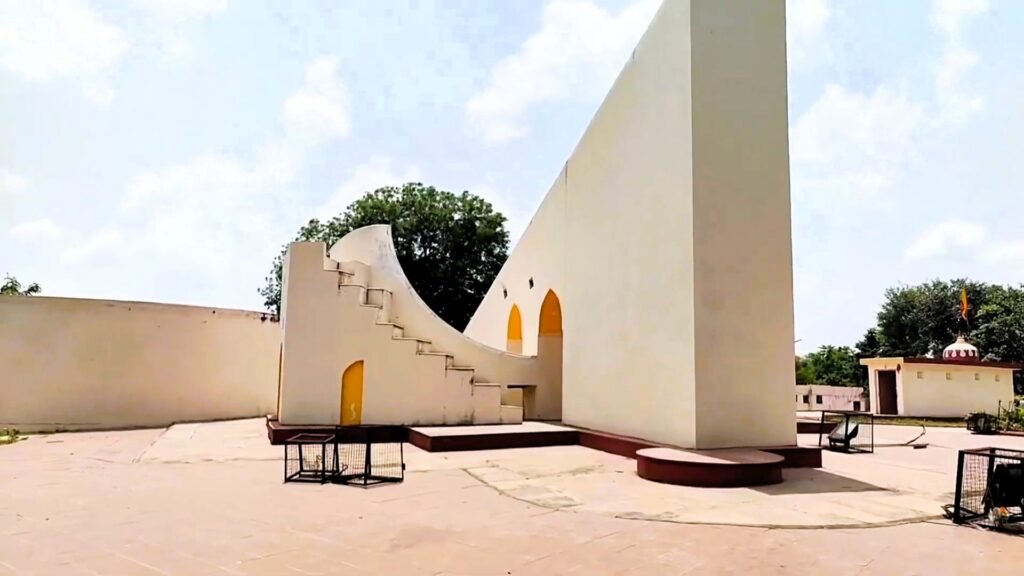
Samrat Yantra | The ‘Supreme Instrument’ — a giant equinoctial sundial about 22 feet long, with a staircase set at an angle matching Ujjain’s latitude. It is the most prominent structure at the site and tells local time with high accuracy. |
Nadivalaya Yantra | An equatorial sundial used to track the sun’s position on either side of the equator throughout the year. |
Digansha Yantra | Used to measure the direction, or horizontal angle, of celestial objects like the sun, moon, and stars. |
The Five Jantar Mantars of India
Ujjain’s observatory is one of five built by Jai Singh II across northern India. Out of these, the one at Mathura no longer exists today.
City | Approx. Year Built |
Delhi | 1724 |
Jaipur | 1728-1734 |
Ujjain | 1725, rebuilt 1974 |
Varanasi | 1737 |
Mathura | Built, later destroyed before 1857 Mathura observatory no longer exists. |
What Makes Ujjain’s Jantar Mantar Different
- It is one of the oldest of the five, with construction believed to have started around 1719.
- Unlike some of the other sites, it remains an active research location — an ephemeris (a yearly record of planetary positions) is still published here.
- It is smaller in scale compared to the Jaipur and Delhi observatories, so visitors expecting something as massive as Jaipur’s Samrat Yantra may find Ujjain’s version more modest.
- A small planetarium (taramandel) inside hosts short shows on planets, stars, and constellations.
- The site was renovated in 1923 by the Maharaja of Gwalior, which helped preserve the original instruments.
Tips for a Better Visit
- Visit around noon for the clearest sundial readings.
- Hire a local guide on-site — the instruments are easier to understand with an explanation of how each one works.
- Carry water and a cap, as most of the complex is outdoors with little shade.
- Combine the visit with the nearby Mahakaleshwar Temple and Ram Ghat to make the most of your time in the area.
Conclusion
The Jantar Mantar of Ujjain is not just a historical relic — it is a working reminder of how precisely ancient Indian astronomers measured the sky using only stone, geometry, and the sun’s shadow. If you are visiting Ujjain for its temples, this short detour offers a completely different side of the city’s heritage: one rooted in science rather than ritual.
Every destination has a story, and your journey is just beginning. Continue your adventure with our specially curated Ujjain Tour Packages and Madhya Pradesh Tour Packages, where spirituality, history, culture, and comfort come together. Whether you’re travelling with family, friends, or on a solo pilgrimage, our thoughtfully planned tours promise a seamless and enriching experience from start to finish.
Frequently Asked Questions
Is the Ujjain Jantar Mantar still used for astronomy?
Yes. Unlike a purely historical monument, it continues to be used for basic astronomical observation, and an annual calendar of planetary movements is published from here.
How is it different from the Jantar Mantar in Jaipur or Delhi?
All three were built by the same ruler, Jai Singh II, but Ujjain’s observatory is smaller in scale. Jaipur’s is the largest and most elaborate of the five.
How much time should I plan for the visit?
Around 30 to 60 minutes is enough to see the main instruments and understand their purpose, especially with a guide.
Is it close to other Ujjain attractions?
Yes, it is located close to the Mahakaleshwar Temple area, so it fits easily into a half-day sightseeing plan.
Get Call back From travel expert
Related Posts
Most Popular Ujjain Tour Package
Ujjain Itinerary for 2 Days
- 1 Night 2 Days
Form
INR 4200 Per Person INR 6972
Ujjain Itinerary for 2 Nights 3 Days
- 2 Night 3 Days
Form
INR 6747 Per Person INR 9747
Ujjain Itinerary for 3 Nights 4 Days
- 3 Night 4 Days
Form